Introduction to LabVIEW and its Applications
LabVIEW Environment: Front Panel & Block Diagram
Basics of Dataflow Programming, Controls and Indicators
Creating and Running Simple VIs (hands-on)
NI Example Finder and NI MAX Overview
Hands-on NI DAQ
Introduction to NI Nigel
Q&A and Discussion
The LabVIEW programming environment simplifies hardware integration for engineering applications, enabling consistent data acquisition from both NI and non-NI hardware. Data acquisition using LabVIEW involves developing software on top of appropriate hardware to collect data from various sensors such as temperature, pressure and current. This data is then processed, filtered, displayed and recorded for further analysis.
 Venue
Venue
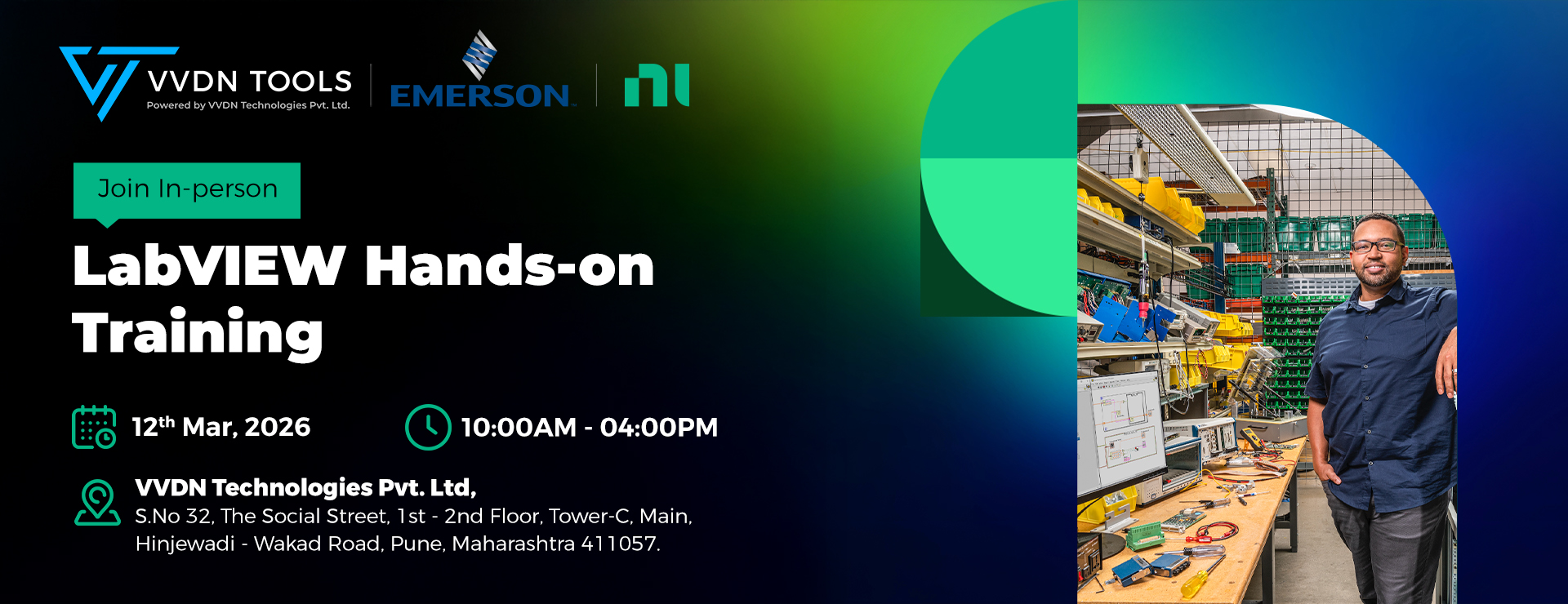
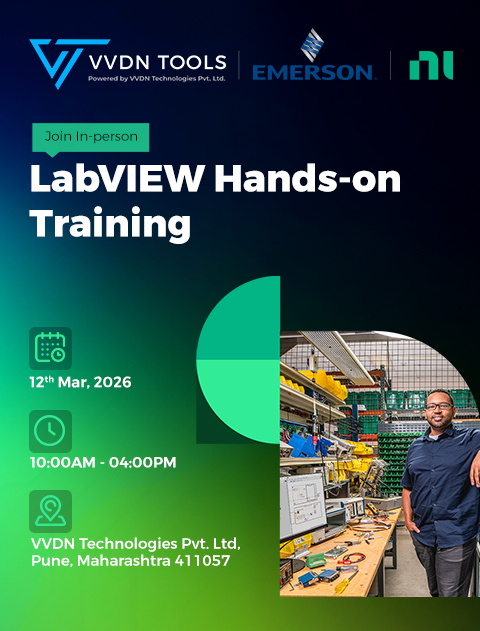
S.No 32, The Social Street, 1st - 2nd Floor, Tower-C, Main, Hinjewadi - Wakad Road, Pune, Maharashtra 411057
 Mark the date
 Agenda
| Timings | Sessions |
|---|---|
| 10:00 AM - 11:15 AM | Fundamentals of LabVIEW |
| 11:15 AM - 11:30 AM | Tea Break |
| 11:30 AM - 01:00 PM | Hands-on |
| 01:00 PM - 02:00 PM | Lunch |
| 02:00 PM - 03:30 PM | Data Acquisition using LabVIEW through cDAQ System |
| 03:30 PM - 04:00 PM | Q & A |
Professors and researchers involved in the development and advancement of electric vehicles (EVs) and related technologies.
Researchers and academicians working in the fields of sensing technologies, data acquisition, and signal processing.
Researchers and enthusiasts interested in the latest developments in 5G/6G communication systems and their applications.
Researchers, and technologists exploring innovations in medical sensing, diagnostics, and healthcare delivery systems.
Engineers and researchers working in the semiconductor industry, including design, test and applications of semiconductor devices.